Tuesday, March 13, 2012

PAIR OF BRACELETS, GOWA - SOUTH SULAWESI


Type: Bracelets
Classification: Jewelry
Name: PAIR OF BRACELETS
Region: Insular South-East Asia
Culture: GOWA
Origin: Gowa, South Sulawesi, Indonesia
Materials: Silver, gold and stone
Dimensions: 2,6 x 10 cm (each) 
Function : Arm, wrist and finger jewelry
Description: Gowa was a principality on Sulawesi (Celebes)


Collection:
National Museum of Ethnology
(Rijksmuseum voor Volkenkunde)
Steenstraat 1, Leiden 2300 AE, The Netherlands

Inventory number: 808-2

Publications about the object:
See related literature, Endang Sri Hardiati & Pieter ter Preferred (red), Indonesia - The discovery of the past, KIT Publishers, Amsterdam 2005, p. 171

Publications:
Endang Sri Hardiati & Pieter ter Preferred (red), Indonesia - The discovery of the past, KIT Publishers, Amsterdam 2005, p. 171

Exhibition history:
Exhibited at the exhibition "Indonesia - The discovery of the past," December 17, 2005 - April 17, 2006, in the Nieuwe Kerk in Amsterdam.

Sunday, March 11, 2012

POSO BATTLE HAT


Type: Body Armor
Classification: Head Protector
Name: POSO BATTLE HAT
Indigenous name: SONGKO TADOELAKO
Function: Defenses and protect
Region: Insular South-East Asia
Culture: POSO
Origin: Poso, Central of Sulawesi, Indonesia
Time period: ---
Materials: Rattan, wood and goat hair
Dimensions: 10 cm H; Dm 21 cm

Collection:
National Museum of Ethnology
(Rijksmuseum voor Volkenkunde)
Steenstraat 1, Leiden 2300 AE, The Netherlands

Inventory number: 43-9

publications about the object:
Traditional weapons of the Indonesian Archipelago

NIAS BATTLE HELMET


Type: Body Armor
Classification: Head Protector
Name: NIAS BATTLE HELMET
Indigenous name: TAKOELA TEFAO
Function: Defenses and protect
Region: Insular South-East Asia
Culture: NIAS
Origin: South NIAS, NIAS Island, Indonesia
Time period: ---
Materials: Iron
Dimensions: H 13.5 cm, Dm 16 to 20.5 cm

Collection:
National Museum of Ethnology
(Rijksmuseum voor Volkenkunde)
Steenstraat 1, Leiden 2300 AE, The Netherlands

Inventory number: 1002-123

publications about the object:
Traditional weapons of the Indonesian Archipelago

The Submission of Prince Dipo Negoro to General De Kock


Title: The Submission of Prince Dipo Negoro to General De Kock
Year: 1830
Artist: Nicolaas Pieneman
Technique: Oil on canvas
Dimensions: 77 x 100 cm
Object number: SK-A-2238

Collection:
Rijksmuseum, The Masterpieces and Infocentre
(The New Rijksmuseum)
Jan Luijkenstraat 1, 1071 CJ Amsterdam

Description:
General Baron de Kock resolutely points to the carriage standing ready, while his adjutant, Major de Stuers, watches determinedly. The Javanese prince, Dipo Negoro, descends the steps and looks out over the gathered crowd. In a show of extreme devotion, two figures kneel at his feet. On the ground, in token of the surrender, lie a number of spears belonging to Dipo Negoro's followers. This is all taking place at the residence in Magelang on Java. It is 28 March 1830. After a three-hour long interview with the General, Prince Dipo Negoro was arrested. This was against the agreement: he was to have been released. Dipo Negoro was forced into exile. This was the formal end of the interminable Java War.

The Java War:
Prince Dipo Negoro and Baron de Kock fought on opposite sides in the Java War, waged from 1825 to 1830. The war had erupted in the struggle for succession to the throne of Yokyakarta, an area of Java ruled by local princes. Vague promises to Dipo Negoro, that he would be the old sultan's successor, were not met by the Dutch. In response the prince unleashed a revolt that found support among large sections of the population. The war cost the lives of some 200,000 Javanese and 15,000 Dutchmen.

Saturday, March 10, 2012

NIAS BATTLE TUBE


Type: Body Armor
Classification: Weapons & Armor
Name: NIAS BATTLE TUBE
Indigenous name: BARO
Function: Defenses and protect
Region: Insular South-East Asia
Culture: NIAS
Origin: NIAS, NIAS Island, Indonesia
Time period: ---
Materials: Bark, rattan and fibers (palm spikes)

Dimension: 62 cm (length)
Inventory number: 985-1

Collection:
National Museum of Ethnology
(Rijksmuseum voor Volkenkunde)
Steenstraat 1, Leiden 2300 AE, The Netherlands

Publications about the object:
Traditional weapons of the Indonesian Archipelago, Endang Sri Hardiati & Pieter ter Preferred (red), Indonesia - The discovery of the past, KIT Publishers, Amsterdam 2005

Friday, March 9, 2012

BUGIS BATTLE ARMOR


Type: Body Armor
Classification: Weapons & Armor
Name: BUGIS BATTLE ARMOR

Indigenous name: LAMENA
Function: Defenses and protect
Region: Insular South-East Asia
Culture: South Sulawesi
Origin: Makassar, Soth Sulawesi, Indonesia
Time period: ---
Materials: Brass, copper and Izer

Dimension: 65 x 45,5 cm
Inventory number: 522-1

Collection:
National Museum of Ethnology
(Rijksmuseum voor Volkenkunde)
Steenstraat 1, Leiden 2300 AE, The Netherlands

Publications about the object:
See related literature: Traditional weapons of the Indonesian Archipelago, Endang Sri Hardiati & Pieter ter Preferred (red), Indonesia - The discovery of the past, KIT Publishers, Amsterdam 2005, p.162

Publications:
Endang Sri Hardiati & Pieter ter Preferred (red), Indonesia - The discovery of the past, KIT Publishers, Amsterdam 2005, p. 162 

Exhibition history:
Exhibited at the exhibition "Indonesia - The discovery of the past," December 17, 2005 - April 17, 2006, in the Nieuwe Kerk in Amsterdam. 

Thursday, March 8, 2012

JAVA WEDHUNG


Type: Wedhung / Machete
Classification: Weapons
Name: JAVA WEDHUNG
Region: Insular South-East Asia
Where it was made: Karanggayam, Java's North Coast, Indonesia
Culture: Java
Time period: 19th Century
Materials: Gold, Wood, Rattan, Buffalo horn and Steel

Dimension: 34,5 (L); 8,3 cm (B)
Inventory number: 963-4

Collection:

National Museum of Ethnology
(Rijksmuseum voor Volkenkunde)
Steenstraat 1, Leiden 2300 AE, The Netherlands

Sunday, March 4, 2012

EFFIGY PORTRAIT OF A CHIEF (MEJAN)


Type: Stone Sculpture
Classification: Sculpture
Name: EFFIGY PORTRAIT OF A CHIEF (MEJAN)
Region: Insular South-East Asia
Where it was made: Indonesia. Sumatra, Barus region (coastal harbour in the Indian Ocean)
Culture: Batak, Toba subgroup
Time period: 19th Century
Materials: Stone
Dimension: 87 cm (height)
Object ID: INV. 3137
Acquired from Emile Deletaille in 1979

Collection:
BARBIER-MUELLER MUSEUM OF GENEVA
Rue Jean-Calvin, 10, 1204 Genève


Descriptions:


Effigies mejan of well-known figures, often with the joint roles of village chief (raja) and magician (datu) were sculpted only by the South Pakpak (who probably invented them), the western Toba (the rare ‘couples’ – horseman and seated woman – seen on Samosir Island are very late) and the Simalungun, where their appearance is very different to this one.

I did several field studies between 1974 and 1998 to identify certain styles specific to the magiciansculptors (datu panggana) of the Pakpak, Simsim, Pakpak Kalasan (previously unknown) and western Toba subgroups. Stone equestrian portraits (mejan) of chiefs are usually accompanied by portraits of their wives, depicted seated, nude or, later, wearing a sarong.

The man’s mount is often, as here, a singa, a mythological monster representing a god of the subterranean world, Raja Padoha (or Naga Padoha), a kind of giant horned snake. The flowing lines of this and the following sculpture (the wife of this raja, whose rank is attested by her armband) are specific to the mountainous region between the coast and Pusuk, where the benzoin and camphor, which once made the fortune of the Barus, was produced since Antiquity. The style of the highland Barus is incontestably derived from that of the Pakpak Kalasan, who are separated from the Pakpak Simsim by a mountain range and interspersed in the west Toba region. Their clans (less than a dozen) were all founded by a chief from a Toba clan.

Nevertheless, they claim (like the Pakpak Simsim) to have received, some fifty generations (four to five hundred years) ago, the teaching of an elderly sage from India called Guru Kalasan, who taught them to cremate their dead. Thus, instead of the large sarcophagi containing bones of the Toba and Simalungun, they have small urns for the ashes, which are placed in front of equestrian statues, many of which have disappeared. Sometimes the mount is a horse or an elephant. Here, it is a singa, recognisable by its long curved tongue, which some early travellers mistook for a trunk.


Jean Paul Barbier-Mueller
Arts of Africa and Oceania. Highlights from the Musée Barbier-Mueller, musée Barbier-Mueller & Hazan (eds.), 2007: p. 258.

EFFIGY PORTRAIT OF THE WIFE OF A CHIEF


Type: Stone Sculpture
Classification: Sculpture
Name: EFFIGY PORTRAIT OF THE WIFE OF A CHIEF
Region: Insular South-East Asia
Where it was made: Indonesia. Sumatra, Barus region (coastal harbour in the Indian Ocean)
Culture: Batak, Toba subgroup
Time period: 19th Century
Materials: Stone
Dimension: 92 cm (height)
Object ID: INV. 3138

Collection:
BARBIER-MUELLER MUSEUM OF GENEVA
Rue Jean-Calvin, 10, 1204 Genève

Descriptions:

The Batak Toba, Pakpak and Simalungun have two kinds of anthropomorphic statues: those depicting high-ranking men and women (sculpted during their lifetime or after death), and the pangulubalang, which have powerful defensive and offensive magic powers and were often sculpted to defend themselves from those of an enemy village.

The Batak Karo probably had small stonepangulubalang but no effigy of a chief has yet been seen. The same seems to be true of the two last Batak groups in the south, the Angkola and Mandailing, Islamised for almost two centuries.

The history of this portrait of a noblewoman is probably the same as the statue of Ronggur ni Ari, wife of Raja Ranjo Simanjuntak which I saw and photographed several times before 1988 at Huta Parik Sinombah, near Barus. It was sold by the villagers around 1990, reappeared on the international art market in 1993, when it was acquired by us, and is now in the Musée du Quai Branly, Paris.

This woman of Pakpak Simsim origin must indeed have been remarkable as her husband, who commissioned the work, did not have his equestrian statue sculpted. And, like this unknown woman, she is wearing her hair in a chignon with a hole in it. The first time I saw Ronggur ni Ari beneath her banyan tree, she had a bouquet of sacred leaves in her hair, placed in this hole, which was made for this precise purpose.

Both female statues were undoubtedly carved by two extremely gifted local datu panggana. We know of other sculptures within a limited radius, identical in style, without the squarer face and heavy jaw of the human depictions of the Pakpak and (later) Toba in the Lake Toba region. They have a characteristically very curved back, originally painted with symbolic motifs.

Over the last twenty years many Batak stone monuments have been destroyed due to lack of protection. They are seen as hindrances to the Islamisation of villages who still honour their ancestors and observe traditional customs.


Jean Paul Barbier-Mueller
Arts of Africa and Oceania. Highlights from the Musée Barbier-Mueller, musée Barbier-Mueller & Hazan (eds.), 2007: p. 261.

Saturday, March 3, 2012

The Royal Crown of BANTEN Kingdom, 18th Century, Banten - West Java


Type: Crown
Classification: Royal Regalia
Name: THE ROYAL CROWN OF BANTEN KINGDOM
Time period: 18th Century
Where it was made: Banten, Java, Indonesia
Materials: Gold, precious stones, enamel, metal
Measurements: 17.0 x 11.5 cm (outer crown)

Collection:
MUSEUM NASIONAL INDONESIA (Museum Gajah)
Jalan Medan Merdeka Barat no.12,
Jakarta Pusat, DKI JAKARTA 10110, INDONESIA

Descriptions:
The crown and its foliate design reflect Javanese decorative traditions that evolved with the rise of the Islamic kingdoms. Crowns, in a wide range of styles, are an important part of the royal heirloom regalia in many parts of Southeast Asia.


Friday, March 2, 2012

JAVA Kris


Type: Keris
Classification: Weapons
Name: JAVA KRIS
Time Period: Wilah / Blade (16th Century), Warangka / Hilt (19th Century)
Where it was made: Java, Indonesia
Materials: Wood, steel, gold and brass
Full length: 51 cm; Blade length: 38 cm

C0llection:
The JORGE CARAVANA Collection
Museu de Évora

Largo Conde de Vila Flor
7000-804 ÉVORA, Portugal


Descriptions:

This Kris, datable to the 16th and 19th centuries comes from Java in the East Indies. It has a straight, double edged blade in watered steel, with a beautiful and unusual pamor, or pattern, known as Dapur Lurus meaning “running waters”. It shows two Ganesha trunks one facing the other – a double Telale Gadjah, which is also unusual.

The ganjah, or blade’s base, is chiselled in basse-relief with a floral motif decoration covered in gold. This type of complex blade is known as Dapur Jalak Ngore.

The gandar or scabbard, topped by the wrangka or ship, shaped like a Chinese ship – ladrang, it has a pendok, or long part of the scabbard, in profusely decorated with a single pattern of chiselled vegetal motifs in high-relief.

The hulu, or hilt, made of wood has the Surakarta shape, typical from the island of Java.

Bibl.: Cameron Stone, 1999, pp. 382-394, fig. 481/7

JAVA Kris


Type: Keris
Classification: Weapons
Name: JAVA KRIS
Time Period: 18th / 19th Century
Where it was made: Java, Indonesia
Materials: Steel, mammoth molar, silver.
Full Length: 47 cm; Blade Length: 35 cm

Koleksi :
The JORGE CARAVANA Collection
Museu de Évora

Largo Conde de Vila Flor
7000-804 ÉVORA, Portugal 


Descriptions:

This original Malay Kris executed with great quality and very rare, comes from one of the largest Malay edged weapons collections in Indonesia, and is datable from the 18th/19th centuries.

Both the hulu, and hilt, of the Kris as the mouth of its pendok, long part of the scabbard, are sculpted in mammoth’s (mastodon) molar, a very rare and appreciated raw material in the East Indies.

In the Middle Ages Siberia was already exporting mammoth and narwhal teeth both to China and Europe through Russia. The objects in the Vatican’s collection which were considered most valuable in the 17th century were giant narwhal’s teeth, then associated with the mythical unicorn.

The teeth of great pachyderms sometimes used in the manufacture of high quality weapons in the Eastern Indies and China are also a part of this group.

This piece is of exceptional beauty in the colours that come through the polish, presenting, however, an ancient restoration work on one of the extremities of the scabbard, which is normal seeing as it is an easily breakable raw material.

The wrangka, or ship, is of the Gayaman style. The blade is also high quality, forged in alternating layers of iron and nickel as if it was “puff pastry”, with a Rekan (desired) pamor, a beautiful pattern called klabang sewu (centipede): in it you put together two piles of iron and nickel blades interlaced like the shuffling of a deck of cards. All this under the heat of the furnace and thousands of hammerings on the anvil ended up creating a blade exceptional in all aspects – the straight dapur lurus blade.

The hilt is of the Yogjakarta style.

Previously from: Rainer Daehnhardt’s collection.

Bibl.: Cameron Stone, 1999, pp. 382-394, fig. 482/3  

Thursday, March 1, 2012

SILK CEREMONIAL JACKET (BAJU) WITH GOLD BROCADE


Type: Ceremonial Customs

Classification : Customs
Name : 
SILK CEREMONIAL JACKET (BAJU) WITH GOLD BROCADE 
Time Period: 19th Century
Materials : Silk and gold brocade
Where it was made: Aceh, Sumatera, Indonesia

Length: 46cm, width (with arms outstretched): 163cm 

Trade by:
Michael Backman Ltd
1 New Burlington Street, London, W1S 2JD
United Kingdom

Descriptions:

This jacket of purple and yellow silk with gold brocade applique over a calico lining is from Sumatra, Indonesia and probably dates to the 19th century. Possibly it is from Aceh. It might also have been worn be the Minangkabau people who imported silk clothing items from Aceh.

The manner of the gold stitching work is highly suggestive of Arab influence. This is not surprising as there were many trade and diplomatic links between the courts of the Middle East and also the Ottoman empire. The applied gold motifs to the lower section of the front of the jacket also suggest Chinese influence: clearly the motifs are based on stylised dragons.

Such a jacket almost certainly was made for a man, to be worn at his wedding.

A vest with related gold brocade applique work which is attributed to Aceh, before 1878, is illustrated in Brinkgreve & Sulistianingsih (2009, p. 157).

The condition is fine - there are no insect holes and no repairs, but there are some splits across the shoulders to the silk along the creaselines. Also, some of the gold brocade has become unstitched. These age-related matters most likely can be resolved with some minor conservation.

Provenance: From a Belgium private collection; acquired by the family of the previous owners directly from Sumatra during the 1920s.

References:

  1. Brinkgreve F, & R. Sulistianingsih (eds), Sumatra: Crossroads of Cultures, KITLV Press, 2009.
  2. Islamic Arts Museum Malaysia, The Message and the Monsoon: Islamic Art of Southeast Asia, IAMM Publications, 2005.
  3. Leigh, B., Hands of Time: The Crafts of Aceh, Penerbit Djambatan, 1989.
  4. Summerfield, A., & J., Walk in Splendor: Ceremonial Dress and the Minangkabau, UCLA Fowler Museum of Cultural History, 1999.
 Inventory no.: 1498

KRIS HILT IN BALI STYLE


Type: Kris Hilt
Classification: Weapons
Name : KRIS HILT IN BALI STYLE
Time period: 19th Century
Materials : Gold
Where it was made: Bali, Indonesia
Object ID: 
70.2/7085 

Collection:
AMERICAN MUSEUM OF NATURAL HYSTORY
Central Park West at 79th Street, New York, NY, 10024-5192

Wednesday, February 29, 2012

THE ROYAL (QUEEN'S) CROWN OF SINGARAJA KINGDOM


Type: Crown
Classification: Royal Regalia
Name: THE ROYAL (QUEEN'S) CROWN OF SINGARAJA KINGDOM
Time period: Late 19th Century
Where it was made: Singaraja, Bali, Indonesia
Materials: 
Gold, rubies, sapphires, and diamonds
Dimension: 6 x 10 1/4 x 8 inches 

Collection:
THE MUSEUM OF FINE ARTS, HOUSTON
1001 Bissonnet Houston, Texas 77005

Gift of Alfred C. Glassell, Jr.
Department of the Arts of Africa, Oceania, & the Americas Arts of the South Pacific

Description:

ROYAL COURT OF SINGARAJA, BALI 
In the 19th century, the royal courts of Bali enjoyed great prosperity and hosted numerous ceremonies and rituals. To assert their right to rule, and to glorify the gods, rulers commissioned artists to create objects of the highest quality. This elegant queen's crown from the court of Singaraja is fashioned in pure gold with diamonds, rubies, and sapphires. Delicate flowers in gold leaf suspended on thin metal wires and springs shimmer with movement.

Bali is an Indonesian island small in size but rich in adornment. Its artistic tradition descends from older Javanese styles and the ornate Hindu style of India. As in most cultures of Indonesia, gold was believed to be empowered and able to cause both good and evil. It was also valued as a symbol of high status. This rare crown may have been commissioned as part of a larger set of royal adornment by King Gusti Agung Gede Agung in 1890 for an important wedding ceremony. Almost all of the artworks in the set are made of pure gold, evidence of great wealth.

Tuesday, February 28, 2012

TWO-PART BUCKLE WITH INLAID STONES


Type: Buckle
Classification: Jewelry
Name: TWO-PART BUCKLE WITH INLAID STONES
Materials: 
Gold and inlaid stones 
Time period: 18th - 19th Century
Where it was made: Indonesia

Culture: Indonesia

Collection:
THE METROPOLITAN MUSEUM OF ART
1000 5th Avenue, New York, NY - USA

Credit Line:

The Samuel Eilenberg-Jonathan P. Rosen Collection of Indonesian Gold, Bequest of Samuel Eilenberg and Gift of Jonathan P. Rosen, 1998


Accession Number: 1998.544.8a, b
This artwork is not on display

JAVA KRIS


Type: Keris
Classification: Weapons
Name: JAVA KRIS
Time Period: ---
Where it was made: Java, Indonesia
Materials: Wood, steel, and gold

C0llection:
de Vries Antiek
Zandstraat 1 5473 RJ Heeswijk-Dinther Netherlands

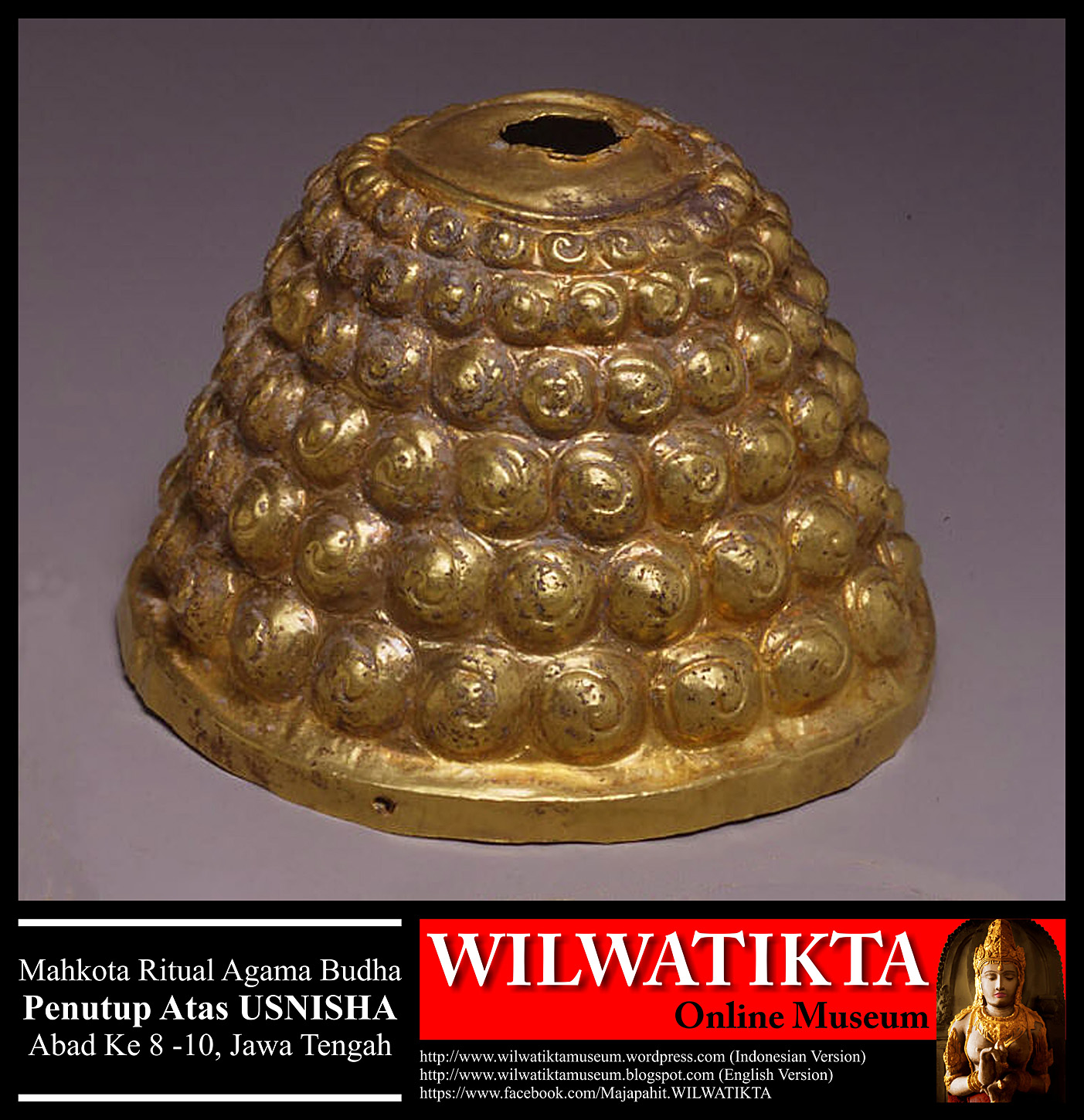
USNISHA COVER


Type: Crown
Classification: Religious Crown
Name: USNISHA COVER
Time period: 
8th–early 10th century
Where it was made: 
Central Javanese, Java, Indonesia
Materials: Gold

Dimensions: H. 2 5/8 in. (6.8cm) 


Collection:
THE METROPOLITAN MUSEUM OF ART
1000 5th Avenue, New York, NY - USA

Credit Line:
The Samuel Eilenberg-Jonathan P. Rosen Collection of Indonesian Gold, Bequest of Samuel Eilenberg and Gift of Jonathan P. Rosen, 1998


Accession Number: 1998.544.9

This artwork is currently on display in Gallery 247

Monday, February 27, 2012

THE TEACHER AGASTYA


The teacher Agastya
Object ID: AK-MAK-238


Collection:
Rijksmuseum, The Masterpieces and Infocentre
(The New Rijksmuseum)
Jan Luijkenstraat 1, 1071 CJ Amsterdam


Type: Sculpture
Materials: Andesite
Measurements: 36 cm, 100 cm, 50 cm
Creator name: Anonymous
Where it was made: Indonesia; Central Java; the Kedu Plain
Time period: 09th Century
Function: Worship

Acquisition:
Long-term loan from the Association of Friends of Asian Art (VVAK), purchased from J.G. Huyser, a collector from The Hague, in 1936

Copyright Acknowledgements:
Owner Vereniging van Vrienden der Aziatische Kunst Museum Rijksmuseum, Amsterdam
Credit line

Why this is a masterpiece:
Assuming an upright pose and exuding calm and authority, this statue of Agastya is not daunting, as befits a teacher. Agastya is an old man, as can be seen by his beard and his thickset figure.

Details of this kind ensure that this delicately worked statue clearly conveys the hallmarks of the deity it represents to the worshipper. It is a convincing example of 9th-century Central Javanese sculpture.

History of the Object:
Statues of Agastya, the divine teacher, always stood in the southern alcove of temples dedicated to Shiva, who was the most important god during Indonesia’s Hindu-Buddhist period (8th-16th century). Temples to Shiva, and statues of Agasya, were found in abundance at the time.

BUGIS KRIS


Type: Keris
Classification: Weapons
Name: BUGIS KRIS
Time Period: ---
Where it was made: Bugis, Sulawesi, Indonesia
Materials: Wood, steel, silver and rattan

C0llection:
de Vries Antiek
Zandstraat 1 5473 RJ Heeswijk-Dinther Netherlands