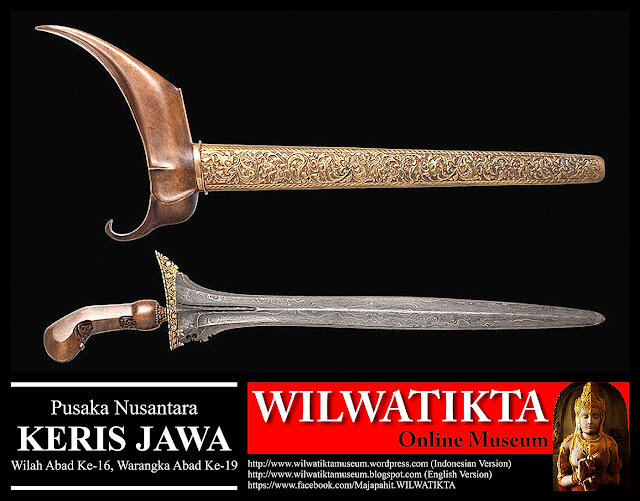
Type: Keris
Classification: Weapons
Name: JAVA KRIS
Time Period: Wilah / Blade (16th Century), Warangka / Hilt (19th Century)
Where it was made: Java, Indonesia
Materials: Wood, steel, gold and brass
Full length: 51 cm; Blade length: 38 cm
C0llection:
The JORGE CARAVANA Collection
Museu de Évora
Largo Conde de Vila Flor
7000-804 ÉVORA, Portugal
Descriptions:
This Kris, datable to the 16th and 19th centuries comes from Java in the East Indies. It has a straight, double edged blade in watered steel, with a beautiful and unusual pamor, or pattern, known as Dapur Lurus meaning “running waters”. It shows two Ganesha trunks one facing the other – a double Telale Gadjah, which is also unusual.
The ganjah, or blade’s base, is chiselled in basse-relief with a floral motif decoration covered in gold. This type of complex blade is known as Dapur Jalak Ngore.
The gandar or scabbard, topped by the wrangka or ship, shaped like a Chinese ship – ladrang, it has a pendok, or long part of the scabbard, in profusely decorated with a single pattern of chiselled vegetal motifs in high-relief.
The hulu, or hilt, made of wood has the Surakarta shape, typical from the island of Java.
Bibl.: Cameron Stone, 1999, pp. 382-394, fig. 481/7
Type: Keris
Classification: Weapons
Name: JAVA KRIS
Time Period: 18th / 19th Century
Where it was made: Java, Indonesia
Materials: Steel, mammoth molar, silver.
Full Length: 47 cm; Blade Length: 35 cm
Koleksi :
The JORGE CARAVANA Collection
Museu de Évora
Largo Conde de Vila Flor
7000-804 ÉVORA, Portugal
Descriptions:
This original Malay Kris executed with great quality and very rare, comes from one of the largest Malay edged weapons collections in Indonesia, and is datable from the 18th/19th centuries.
Both the hulu, and hilt, of the Kris as the mouth of its pendok, long part of the scabbard, are sculpted in mammoth’s (mastodon) molar, a very rare and appreciated raw material in the East Indies.
In the Middle Ages Siberia was already exporting mammoth and narwhal teeth both to China and Europe through Russia. The objects in the Vatican’s collection which were considered most valuable in the 17th century were giant narwhal’s teeth, then associated with the mythical unicorn.
The teeth of great pachyderms sometimes used in the manufacture of high quality weapons in the Eastern Indies and China are also a part of this group.
This piece is of exceptional beauty in the colours that come through the polish, presenting, however, an ancient restoration work on one of the extremities of the scabbard, which is normal seeing as it is an easily breakable raw material.
The wrangka, or ship, is of the Gayaman style. The blade is also high quality, forged in alternating layers of iron and nickel as if it was “puff pastry”, with a Rekan (desired) pamor, a beautiful pattern called klabang sewu (centipede): in it you put together two piles of iron and nickel blades interlaced like the shuffling of a deck of cards. All this under the heat of the furnace and thousands of hammerings on the anvil ended up creating a blade exceptional in all aspects – the straight dapur lurus blade.
The hilt is of the Yogjakarta style.
Previously from: Rainer Daehnhardt’s collection.
Bibl.: Cameron Stone, 1999, pp. 382-394, fig. 482/3
Type: Keris
Classification: Weapons
Name: JAVA KRIS
Time Period: ---
Where it was made: Java, Indonesia
Materials: Wood, steel, and gold
C0llection:
de Vries Antiek
Zandstraat 1 5473 RJ Heeswijk-Dinther Netherlands
Type: Keris
Classification: Weapons
Name: JAVA KRIS
Time Period: ---
Where it was made: Java, Indonesia
Materials: Ivory, wood, steel, brass, silver and diamonds
C0llection:
de Vries Antiek
Zandstraat 1 5473 RJ Heeswijk-Dinther Netherlands
Type: Keris
Classification: Weapons
Name: JAVA KRIS
Time Period: ---
Where it was made: Java, Indonesia
Materials: Wood, steel, brass, gold enamel and diamonds
C0llection:
de Vries Antiek
Zandstraat 1 5473 RJ Heeswijk-Dinther Netherlands


